

General & administrative (G&A) expenses are the operational costs required to keep a business running, separate from producing goods or selling services. For busy professionals, accurately tracking these costs is not just an accounting task—it is fundamental to financial control and tax compliance.
This guide provides a direct, practical overview of G&A expenses for business consultants, freelancers, small business owners, and employees who manage expense reports.
Understanding Core Business Overheads
A G&A expense is any cost that supports the entire business, not a single, revenue-generating department like production or sales.
For a management consultant at Deloitte or BCG, a flight to a client site is a direct project cost. The subscription for the firm's accounting software, however, is a G&A expense. For a small business owner, the materials for their product are not G&A, but the salary for their office manager is.
Correctly classifying these expenses is critical for accurate financial reporting and tax compliance. Professionals from the DACH region to Canada face this challenge. It is the primary reason tax advisors receive a shoebox full of unsorted receipts, leading to avoidable back-and-forth with accounting departments.
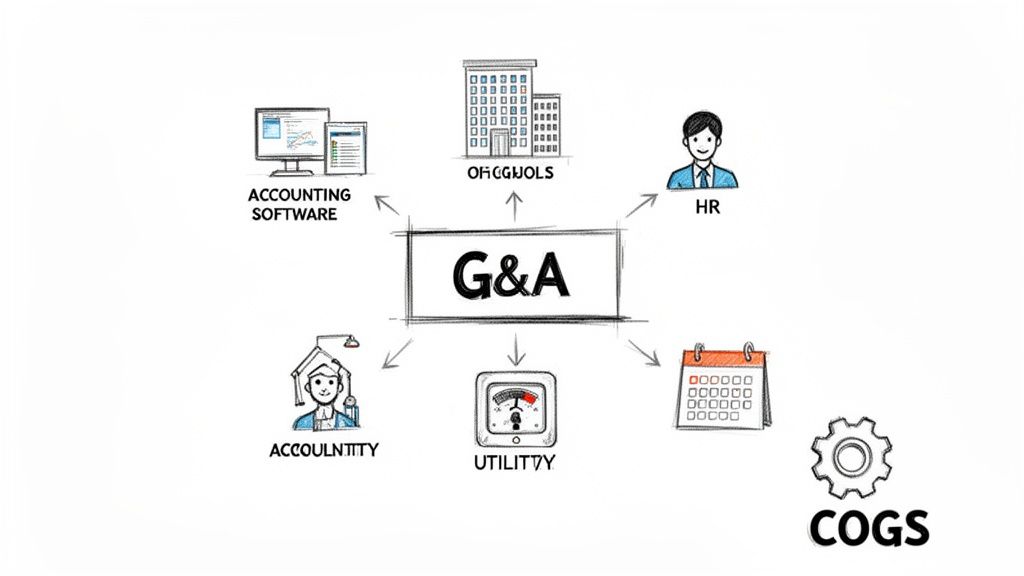
Why This Separation Matters
Categorising G&A costs correctly provides a clear view of a company's operational efficiency. Separating these expenses allows you to accurately diagnose the financial health of the business.
For example, if G&A costs are rising while revenue remains flat, it may indicate inefficient operations or excessive overheads. For a self-employed architect or lawyer in a regulated industry, every pound or euro spent on non-essential administration directly reduces their net income.
G&A expenses are reported on a company's income statement, below the Cost of Goods Sold (COGS). Subtracting both COGS and G&A from revenue reveals the company's operating income—a key indicator of profitability from core business activities.
Key Examples of G&A Expenses
The following are common G&A expenses for professionals in the UK, USA, Singapore, and beyond:
- Salaries: Compensation for non-sales and non-production staff, including executives, HR, and finance teams.
- Office Rent and Utilities: Costs for physical workspaces, including electricity, water, and internet.
- Professional Services: Fees for external support, such as legal counsel, accounting services, or IT consulting.
- Software and Subscriptions: Costs for business-wide software not directly used in production, such as accounting platforms (e.g., Lexware) or HR systems.
- Insurance: Premiums for general business liability, property, and workers' compensation policies.
Mastering this concept is the first step toward controlling your company's financial performance. It ensures every expense is allocated correctly for effective budgeting and tax preparation.
How G&A Differs From Other Business Costs
Accurate financial reporting depends on placing expenses in the correct category. For anyone managing a budget or preparing financial statements, misclassifying costs can distort a company's perceived profitability and create tax compliance issues. Understanding the difference between general & administrative expenses and other major cost categories is essential.
The two areas most often confused with G&A are the Cost of Goods Sold (COGS) and Selling Expenses. While all three are necessary costs, they serve distinct functions. If a business is a construction project, COGS are the materials, Selling Expenses are the estate agent's commission, and G&A is the rent for the head office where the plans were drafted.
G&A vs. Cost of Goods Sold (COGS)
To distinguish G&A from COGS, ask one question: "Is this cost directly tied to producing our product or delivering our service?" If the answer is yes, it is COGS. If the cost supports the overall business operation, it is G&A.
- COGS Example: A software company pays for the cloud servers required to run its application for customers. This is a direct cost of service delivery.
- G&A Example: The same company pays for the accounting software its finance team uses. This supports the entire organisation, not the product itself.
A factory worker's wages are COGS, but the salary of the HR manager who hired them is G&A. Misclassifying these costs distorts the gross profit margin, a critical metric for production efficiency.
G&A vs. Selling Expenses
The line between G&A and selling costs can seem ambiguous, but the distinction is equally important. Selling expenses are all costs incurred specifically to acquire new customers and market your products or services. G&A costs are the background operational expenses required to run the business, regardless of sales activity.
The Bottom Line: Selling expenses are focused externally—attracting customers and closing deals. G&A expenses are focused internally—maintaining core business operations.
For instance, the salary and commission for a salesperson who travels frequently between London and Frankfurt are selling expenses. The salary of the CFO who approves their travel budget is a G&A expense.
Understanding the SG&A Umbrella
You will often see the term SG&A (Selling, General & Administrative) on an income statement. This is not a separate category but a consolidation of these two cost types on a single line. G&A is a critical component of the larger SG&A figure.
While some companies report a single SG&A number, separating them provides sharper business insight. A high "S" may indicate an aggressive growth phase, while a high "G&A" could signal operational inefficiencies that require attention.
Whether you are a consultant at McKinsey or a small business owner in Australia, correct classification is vital. It means that when you capture a receipt with a tool like Bill.Dock, you can tag it correctly, leading to accurate financial statements and reliable budgets. To make this clear, the table below outlines the key differences.
Expense Categories at a Glance: G&A vs. COGS vs. Selling Expenses
This comparison helps classify business costs accurately.
| Expense Category | Definition | Examples |
|---|---|---|
| General & Administrative (G&A) | Costs to support the entire business operation, not directly linked to making a product or a specific sale. | Executive salaries, head office rent, utilities, legal fees, accounting software, HR department costs. |
| Cost of Goods Sold (COGS) | Direct costs required to produce the goods or deliver the services your company sells. | Raw materials, factory labour wages, manufacturing overhead, server hosting costs for a SaaS app. |
| Selling Expenses | Costs incurred specifically to market and sell your company's products or services to customers. | Sales team commissions, advertising campaigns, trade show fees, marketing brochures, salaries for the sales team. |
This breakdown facilitates clean, accurate bookkeeping and a true understanding of your business's financial health.
What G&A Expenses Look Like in the Real World
At their core, general & administrative expenses are the essential overheads that support the entire business but are not directly tied to production or sales. The specific nature of these costs varies significantly between businesses.
A freelance consultant in a Berlin home office has a different G&A profile from a project manager at a large firm in Toronto. The key is to identify which costs fit this category for your specific operation.
This chart helps visualise where G&A fits within the broader Selling, General & Administrative (SG&A) framework.
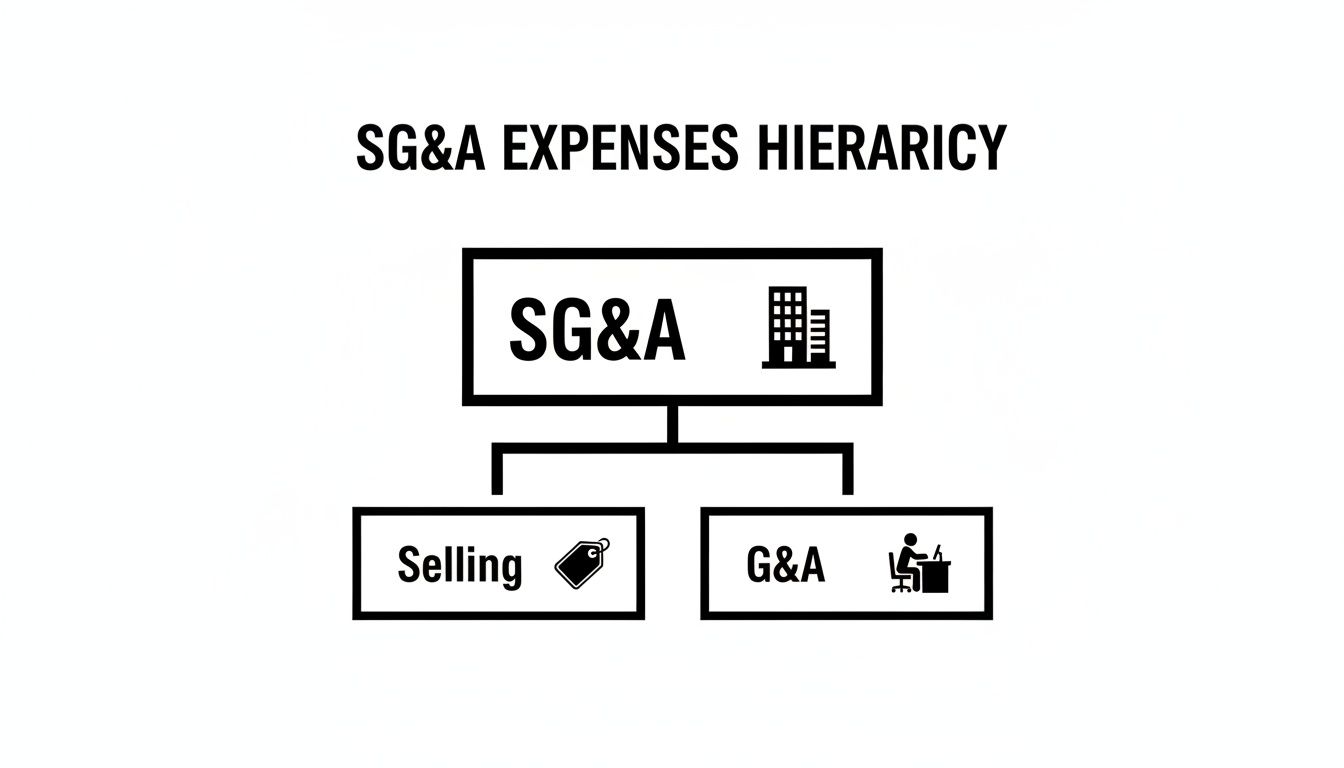
Simply put, G&A costs are for running the business, while selling costs are for growing it. This distinction is critical for accurate financial analysis.
Core People and HR Costs
The costs to manage non-sales and non-production employees are classic G&A expenses. For most companies, this represents the largest portion of their administrative budget.
- Executive Salaries and Benefits: Compensation for C-suite executives and senior managers who guide overall company strategy.
- Admin Staff Wages: Salaries for office managers, receptionists, and executive assistants.
- HR and Finance Department Salaries: Payroll for internal accounting, bookkeeping, and human resources teams.
- Recruitment Costs: Fees for hiring corporate, non-sales roles.
For large consulting firms like McKinsey or Accenture, these costs cover the extensive back-office teams supporting consultants globally. We explore this in our guide on expense management for business consultants.
Office, Facilities, and Operational Overheads
This category includes costs related to the physical and digital workspaces for your team. This often combines traditional office costs with expenses for remote employees.
- Rent and Leases: Payments for headquarters and other administrative offices.
- Utilities: Essential services like electricity, water, heating, and internet for administrative spaces.
- Insurance: Premiums for general business liability, property insurance, and directors and officers (D&O) coverage.
- Office Supplies: Everyday items from printer paper to office coffee.
- Depreciation: An accounting entry that allocates the cost of major assets like office furniture, computers, and buildings over their useful life.
Professional Services and Compliance Costs
Every company requires external expertise. Fees for legal advice or financial audits are general & administrative expenses.
These professional fees are rarely optional. They are critical for risk management and regulatory compliance, making them essential to track for accurate budgeting.
This typically includes:
- Legal Fees: Costs for corporate legal work, such as contract review or advice on company structure.
- Accounting and Audit Fees: Payments to external CPA firms for bookkeeping, tax preparation, or financial statement audits.
- Consulting Fees: Payments for management, IT, or strategy consultants working on high-level company projects.
Technology and Software Costs
Finally, there is the technology that supports the modern business. Any software or IT infrastructure that serves the entire organisation—not just sales or production teams—is a G&A expense.
This category includes:
- Accounting Software: Subscriptions for platforms like SAP Concur, Lexware, or Expensify.
- HR and Payroll Systems: Software for managing employee records, benefits, and payroll.
- General IT Support: Costs for the IT helpdesk and maintenance of internal networks for administrative staff.
- Communication Tools: Subscriptions for company-wide platforms.
How G&A Expenses Affect Financial Performance
General and administrative expenses directly impact profitability, efficiency, and overall financial health. For any business professional, managing these costs is fundamental to sound decision-making.
On an income statement, G&A expenses are subtracted from gross profit to calculate Operating Income. This metric shows how much profit the core business activities generate before interest and taxes. Every pound or euro spent on G&A directly reduces this key profitability figure.
The G&A Ratio: A Key Performance Indicator
The G&A Ratio is a simple but powerful KPI for measuring operational efficiency. It is calculated by dividing total G&A expenses by total revenue, revealing the percentage of each dollar earned that is spent on overheads.
A rising G&A Ratio can be a warning sign. It often indicates that back-office costs are growing faster than sales. Conversely, a falling ratio suggests improving efficiency and financial discipline.
For a self-employed professional in the UK or a small business owner in Australia, this is not just theoretical. An inefficient software subscription or an overpriced office lease directly impacts net income. You can see how smaller costs accumulate in our guide on calculating travel expenses.
The Broader Economic Context
Controlling G&A is more important than ever. A recent study by The Hackett Group found that SG&A expenses in Europe have reached 11.5% of revenue—the highest in a decade. This trend, exacerbated by hybrid work models and supply chain issues, increases pressure on businesses to manage spending.
This economic pressure makes efficient expense tracking a strategic necessity. For a consultant, every hour spent on a manual expense report is an hour not billed to a client. For a freelancer, a single faded thermal receipt with a significant VAT deduction could mean hundreds of euros lost.
Why Disciplined Tracking Is Non-Negotiable
Effective G&A management requires accurate, current data. A shoebox of crumpled receipts makes it impossible to monitor your G&A Ratio or make timely, informed decisions.
A practical workflow for control includes:
- Capture Instantly: Use a mobile application to photograph a receipt immediately. This eliminates lost or faded paperwork. Bill.Dock, for example, offers AI receipt scanning with 95%+ accuracy and supports over 150 currencies.
- Categorise Correctly: Tag each expense as G&A, COGS, or a selling expense within the application.
- Review Regularly: Monitor your dashboard to track G&A spending against budget and revenue in real-time.
- Export Seamlessly: Generate a clean, compliant report (PDF, Excel, CSV) for your accountant at tax time.
This process transforms G&A management from a reactive, year-end task into a proactive, strategic part of your business that protects profits and supports sustainable growth.
Actionable Strategies to Control G&A Expenses
Controlling your general & administrative expenses is a core strategy for protecting profitability. The objective is to reduce the administrative friction that consumes time—time that could be spent with clients or growing the business. A proactive approach with the right tools eliminates last-minute clean-ups.
Manual processes cause significant problems. The Friday afternoon back-and-forth with accounting over a lost receipt or the Sunday evening spent completing an expense report are systemic inefficiencies that can be eliminated.
Automate Expense Capture and Reporting
Manual data entry is a primary source of wasted time in business. The process of saving a paper receipt, entering its details into a spreadsheet, and submitting it for approval is slow and error-prone.
- Instant Digital Capture: Photograph receipts immediately. A consultant on a business trip in Japan can capture a taxi receipt, and the data is captured instantly, with the amount recognised in Japanese Yen.
- AI-Powered Data Extraction: Modern tools use AI to extract key details—merchant, date, amount, and VAT—with high accuracy. This ends manual typing and reduces human error.
- Automated Categorization: Set up rules to automatically sort expenses into the correct categories, such as G&A, travel, or other cost centres. This maintains clean, consistent records for financial analysis.
What was once a tedious chore becomes a quick action on your phone.
This image illustrates the process: a receipt is instantly digitised, processed, and ready for your accounts.
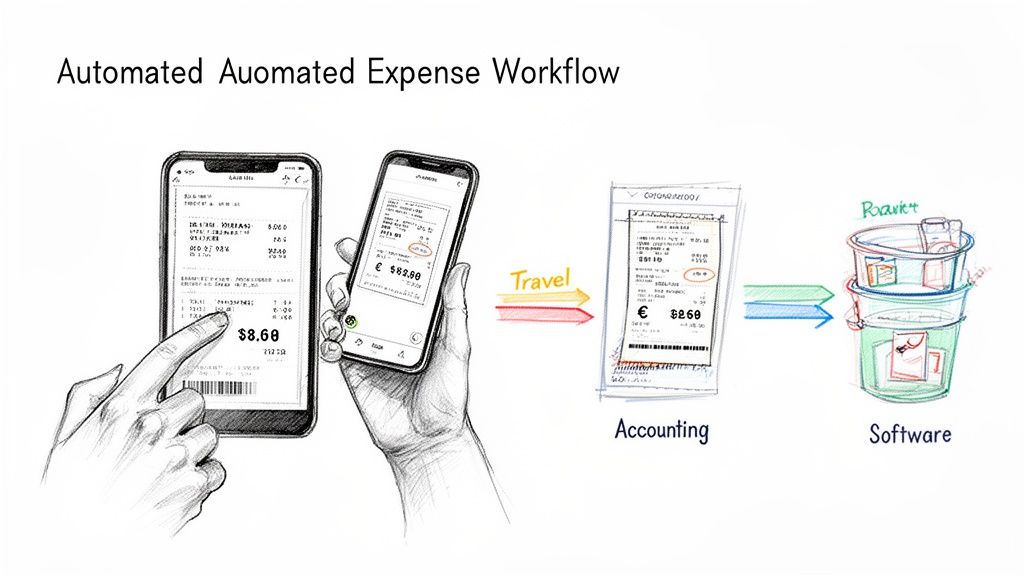 The main benefit is the removal of manual steps, which saves time and creates a real-time, compliant audit trail.
Systematically Review Recurring Costs
Many G&A costs are recurring subscriptions for software or professional services. These can accumulate, and without regular review, you may pay for tools you no longer use.
A quarterly review of all software subscriptions and vendor contracts is a simple, effective discipline. For each one, ask: "Is this tool delivering value proportional to its cost?"
A small business owner might find they are paying for both a project management tool and a separate file-sharing service when one platform could suffice. For larger firms, an audit can reveal redundant licenses or enterprise tools like SAP Concur or Spendesk that are too complex for individual teams, who might be better served by a simpler, mobile-first alternative like Bill.Dock, Rydoo, or Circula. For more on managing these costs, explore our article on expense claims.
Consider Strategic Outsourcing
For non-core business functions, outsourcing can be an effective strategy. It converts fixed G&A salary costs into more flexible, variable expenses, providing access to specialised expertise without the overhead of a full-time employee.
Common areas to outsource include:
- Payroll and Bookkeeping: Using an external accounting firm is often more cost-effective than an in-house team for small and medium-sized businesses.
- Specialized IT Support: Managed service providers can handle network security, troubleshooting, and support instead of a full-time IT administrator.
- Human Resources: Functions like benefits administration and compliance can be managed by third-party HR specialists.
This is a growing trend. The global G&A outsourcing market, valued at USD 7.9 billion, is projected to reach USD 14.1 billion. Organisations can cut overheads by up to 30-40% and allow internal teams to focus on core activities.
By combining automation for daily tasks with strategic reviews and smart outsourcing, you can take control of your general & administrative expenses, turning a burdensome cost centre into a lean, efficient part of your operation.
Frequently Asked Questions
Here are answers to common questions professionals have about general and administrative expenses.
Are Marketing and Advertising Costs G&A Expenses?
No, marketing and advertising are considered 'Selling Expenses,' not G&A. Selling expenses are costs incurred specifically to generate revenue, such as ad campaigns, sales commissions, and promotional events.
G&A expenses are the costs of running the business, such as head office rent, accounting team salaries, and legal fees. Separating these categories on your income statement provides a clearer view of spending on revenue generation versus general operations. This distinction is crucial for financial analysis. High spending in 'Selling' may indicate a growth strategy, whereas a high 'G&A' line could signal operational inefficiency.
How Can a Freelancer or Small Business Track G&A Expenses?
The most effective method is to use accounting software combined with a dedicated expense management tool. This creates a clean, compliant record from the moment of purchase.
A simple two-step workflow is sufficient:
- Set Up Your Categories: Establish a clear Chart of Accounts in your accounting software with specific categories like 'Software Subscriptions,' 'Professional Fees,' or 'Office Utilities.'
- Capture on the Go: Use an application like Bill.Dock to photograph receipts and invoices as you receive them. The tool automatically extracts key data, eliminating manual entry and creating a tax-ready audit trail in real-time. Bill.Dock is GDPR compliant, with data stored on EU servers in Frankfurt, and offers delegate access for sharing with a personal assistant or accountant.
This digital-first approach is the solution to the "shoebox of receipts." Instead of sorting through faded paper at year-end, you have organised, real-time data. This provides a clear view of overheads and helps identify savings opportunities, especially for VAT claims across different countries.
What Is the Difference Between G&A and SG&A?
SG&A is a broader term on an income statement. It stands for Selling, General & Administrative expenses and combines three cost types into one line:
- Selling costs: Such as sales team salaries and advertising.
- General costs: Including head office rent and utilities.
- Administrative costs: Covering executive salaries, legal counsel, and accounting fees.
G&A is a component of SG&A. Some companies consolidate these into a single SG&A line item. Others separate them to provide investors and managers with a more detailed view of spending. Understanding this difference is key to interpreting a company's financial performance.
Stop wasting time on manual expense reports and lost receipts. Bill.Dock uses AI to scan and categorise your expenses with over 95% accuracy, available on Web, iOS, and Android. It is a simple, fast, mobile-first solution for individuals and small businesses. Try it free for 30 days (no credit card required). Annual plans start at €59.
Refined using the Outrank tool